
If you are deciding where to buy a home in Kolhapur this year, you will compare location, carpet area, RERA registration, builder track record and amenities. Most buyers stop there. There is one more number worth adding to that list, and it is the one that quietly decides how your family feels every morning for the next thirty years: the Air Quality Index, or AQI, of the exact spot where the building stands.
This guide explains what Kolhapur’s air looks like in 2026, how to read AQI without any technical background, how to check it yourself before you book, and what a genuinely clean-air home looks like in practice. In the second half we show the actual on-site readings at One Earth, Deshpande Infra’s township on the Rankala lakefront, and why it was designed the way it was.
Kolhapur’s air in 2026: the numbers most buyers never see
Kolhapur has a reputation for clean air compared to Pune or Mumbai. That reputation is a few years out of date. Public monitoring data on aqi.in puts Kolhapur’s running annual AQI (US scale) for 2026 at around 120, which the same source classifies as unhealthy for sensitive groups. The previous years were far lower: 53 in 2020, 57 in 2021, 75 in 2022, 54 in 2023 and 99 in 2025. The city has roughly doubled its average pollution load in five years.
Two patterns inside that data matter for a home buyer.
- The city is not one number. Air quality changes street by street. Readings near stone crusher zones, bus stands and arterial roads run several times higher than readings beside open water or dense tree cover, even on the same day.
- Mornings are the worst. Kolhapur’s daily AQI typically peaks between 6 AM and 9 AM and drops by late afternoon. That is exactly when children leave for school and older parents go for a walk.
Rain temporarily clears the air, which is why a single reading during monsoon can look reassuring. What matters is the reading at your specific plot across the dry months, October to May.
What the AQI number actually means
AQI converts pollutant levels (mainly fine dust called PM2.5 and PM10) into a single score. On the Indian scale used by the Central Pollution Control Board:
- 0 to 50, Good: minimal impact. Safe for outdoor play, morning walks and open windows.
- 51 to 100, Satisfactory: minor breathing discomfort for sensitive people.
- 101 to 200, Moderate: breathing discomfort for children, the elderly and anyone with asthma or heart conditions.
- 201 to 300, Poor: breathing discomfort for most people on prolonged exposure.
- 301 to 400, Very Poor: respiratory illness on prolonged exposure.
- 401 and above, Severe: affects healthy people and seriously impacts those with existing illness.
The difference between living at 40 and living at 200 is not a matter of comfort. It is the difference between opening your windows every evening and running an air purifier in each bedroom.
How to check AQI before you buy a flat in Kolhapur
You do not need equipment. Do these four things before you pay a booking amount.
1. Check the public map for the locality
Open aqi.in or the IQAir app and look at the Kolhapur map, not just the city number. The city has only a small number of official CPCB stations, so treat the map as a rough guide to which side of town is cleaner, not as a reading for a specific building.
2. Visit the site at 7 AM on a weekday
Not at 11 AM on a Sunday when the sales office is quiet and the roads are empty. Go when the city is moving. Stand at the boundary wall and pay attention to what you smell and what you hear. Diesel, dust and horn noise at 7 AM tell you everything.
3. Ask the developer for their own readings
Portable AQI monitors cost a few thousand rupees. Any developer who is serious about air quality will have measured their site and the surrounding junctions and will show you the numbers. If they cannot, that is an answer too.
4. Look at what surrounds the plot, not what is on it
A rooftop garden does not fix a site that sits 200 metres downwind of a crusher. The three things that reliably lower AQI at a residential site are a large body of water nearby, mature tree cover on the approach roads, and distance from heavy vehicle corridors. Water bodies in particular cool the air and settle dust, which is why lakefront housing across India consistently records lower particulate levels than housing on the same city’s ring roads.
What a healthy-air locality in Kolhapur looks like
Put together, the checklist for a clean-air home in Kolhapur reads like this:
- Adjacent to a lake, river or protected green zone rather than an industrial or quarry belt
- At least a few hundred metres from bus stands, highways and truck routes
- A gated boundary with continuous landscaping, so the site itself is not a dust source during and after construction
- Low unit density per floor, so ventilation and cross-breeze are designed in rather than promised
- Sewage treatment, rainwater harvesting and solar on site, because a township that manages its own water and power adds less to the neighbourhood’s pollution load
- A RERA registration you can verify on the MahaRERA portal, so the amenity list you are shown is the one that gets built
If you are new to the last point, our guide to the difference between RERA and MahaRERA explains what the registration actually protects.
One Earth, Rankala lakefront: what the air actually reads
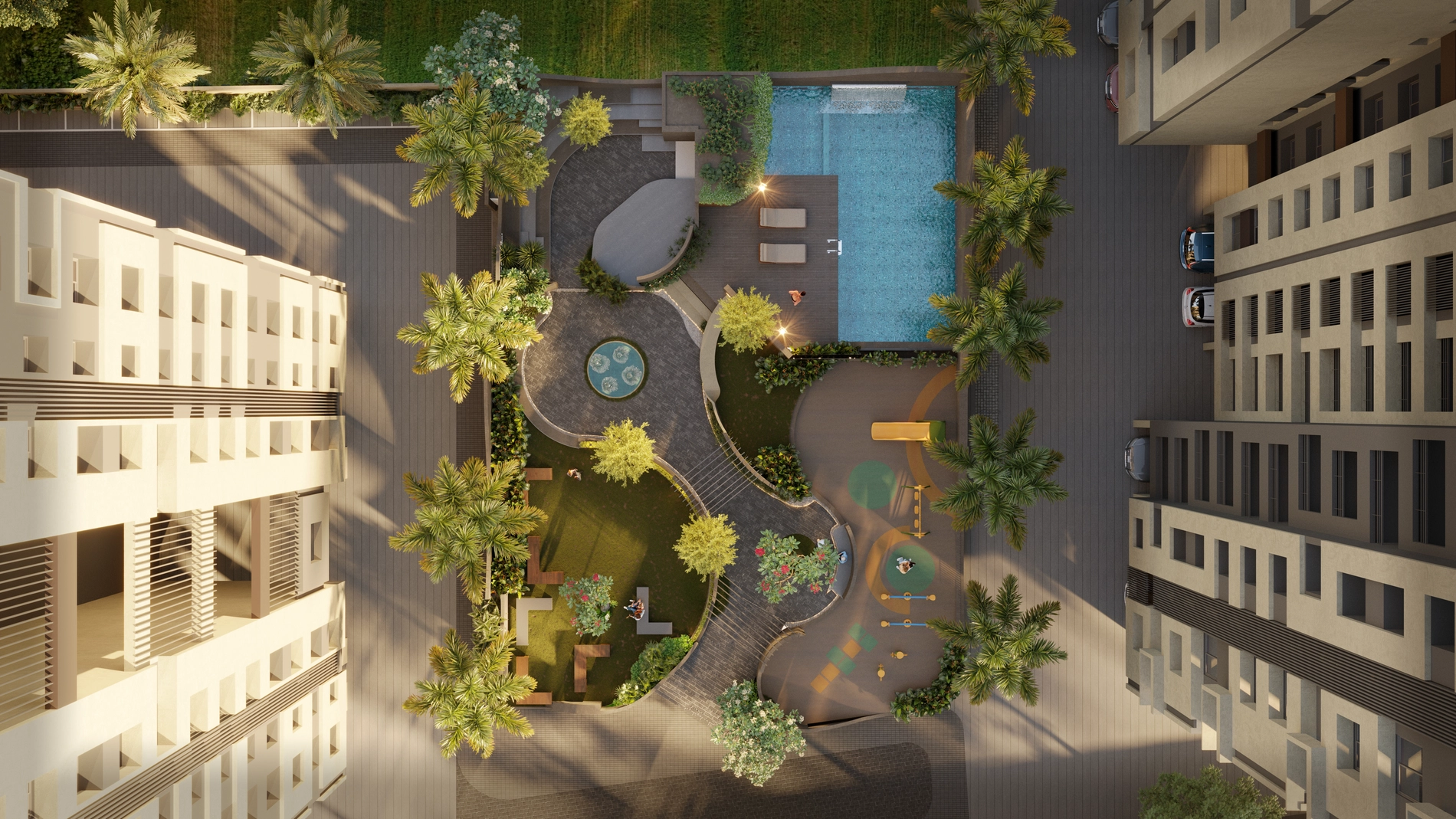
One Earth is a gated residential township on the Rankala lakefront, opposite the Silent Zone at Partala, near Pataudi Ghat and the Shri Krishna Mandir. It is spread across roughly 1.5 acres with three 13-storey towers and 195 homes in 2 BHK and 3 BHK configurations. That works out to five homes per floor, which is unusually low for Kolhapur and is the reason the corridors and balconies get real cross-ventilation instead of recycled air.
We measured it. Using a portable AQI monitor in August 2026, the reading at the One Earth site office came in at 31, in the Good band, with readings across the month staying between 31 and 48. On the same days, at the same time, the monitor was carried to busy points in the city for comparison.
| Location | AQI reading (Aug 2026) | Band |
|---|---|---|
| One Earth site office, Rankala lakefront | 31 to 48 | Good |
| Rankala Stand | 132 and above | Moderate to Poor |
| Crusher Chowk | Up to 411 | Severe |
| Main road and supermarket junction | 132 to 411 | Moderate to Severe |
These are spot readings from a handheld device, not official CPCB station data, and they will vary by day and season. The gap, though, is not subtle. A three to ten times difference in particulate load within a few kilometres of the same city is the whole argument of this article in one table. The lake does the work: open water on one side, no crusher traffic, and a boundary that is landscaped end to end.
Amenities that are built around the air, not just the brochure
Most amenity lists are written to be long. The One Earth list is written to be used every week, and several items directly support the clean-air position of the site.
- Garden area with water bodies inside the township, adding to the cooling and dust-settling effect of the lake outside it
- Walking track along the entire boundary, which means a morning walk at AQI 31 rather than on the main road
- Rooftop party lawn and gazebo viewing deck facing the lake, where migratory birds arrive on the open water every winter
- Open-air amphitheatre for community evenings, only workable because the air outdoors is pleasant enough to sit in
- Swimming pool, gym, indoor games and multipurpose hall, kids play area and guest rooms for daily use
- Solar lighting for parking and common areas, EV charging stations, STP and rainwater harvesting, so the township draws less from the grid and puts less back into the neighbourhood
- Drop-off point with a cascading waterfall and a designer access-controlled lobby with imported flooring, 24×7 CCTV and power backup for lifts, common lighting and pumps
Inside the homes the fittings are Grohe or equivalent CP fittings, American Standard or equivalent sanitaryware, Yale or equivalent digital main door locks, Legrand or equivalent switches, UPVC windows with mosquito nets and safety grills, and Asian Paints TE Shine or equivalent finishes. These are the details that keep maintenance predictable long after possession.
You can walk through the township without visiting: the One Earth virtual tour covers the lobby, open spaces, pool, gym and sample homes.
How One Earth compares on the checklist
| Clean-air checklist item | One Earth |
|---|---|
| Adjacent to a lake or green zone | Yes, Rankala lakefront, opposite Silent Zone Partala |
| Distance from crusher and truck corridors | Yes, residential lakefront pocket |
| Gated boundary with continuous landscaping | Yes, walking track and gardens along the full boundary |
| Low density per floor | Yes, five homes per floor across three towers |
| STP, rainwater harvesting, solar | Yes, all three on site |
| Verifiable RERA registration | Yes, MahaRERA PR1150002501739 |
| Measured on-site AQI | 31 (Good), August 2026 |
Frequently asked questions
Is Kolhapur’s air quality good for living?
It depends heavily on the locality. City-level averages for 2026 sit in the moderate to unhealthy range on public trackers, but lakefront and green pockets such as the Rankala side record readings in the Good band. Check the specific site, not the city figure.
What is the AQI at One Earth Kolhapur?
Handheld readings at the One Earth site office in August 2026 came in at 31, with the month’s readings ranging from 31 to 48, all within the Good band of the Indian AQI scale. These are spot readings and will vary with weather and season.
Which area in Kolhapur has the cleanest air?
Areas next to Rankala Lake and other water bodies, away from the crusher belt and main truck routes, consistently record the lowest particulate readings in the city. Areas around bus stands, arterial roads and quarry zones record the highest.
What configurations are available at One Earth?
One Earth offers 2 BHK and 3 BHK homes across three 13-storey towers with 195 homes in total. Floor plans, carpet areas and current availability are shared on request through the enquiry form on the One Earth project page.
Is One Earth RERA registered?
Yes. One Earth is registered with MahaRERA under registration number PR1150002501739 and is developed by Deshpande Infra in partnership with Revanta.
How do I check AQI myself before buying a flat?
Use a free app such as IQAir or the aqi.in website for the locality map, then visit the site at 7 AM on a weekday and ask the developer for their own on-site readings. A portable monitor costs a few thousand rupees if you want your own numbers.
Next step
If clean air is on your checklist, the fastest way to decide is to stand on the site at 7 AM with the monitor in your hand. Schedule a visit to One Earth and we will bring the AQI monitor and the floor plans. You can also read our guides to buying property near Rankala and what makes the best township in Kolhapur.
MahaRERA registration: PR1150002501739. Disclaimer: This article is for informational purposes only. AQI figures quoted for One Earth are spot readings from a handheld monitor taken in August 2026 and will vary by day, season and weather; city figures are from publicly available third-party trackers and are not verified by Deshpande Infra. Plans, layouts, specifications, amenities and brand names are indicative and subject to change at the developer’s discretion. This article does not constitute an offer or contract; all purchases are governed by the Real Estate (Regulation and Development) Act 2016.
